Prepare a clean working area
Use a dry surface large enough to support the entire print. Remove food, drinks, pens, and rough objects. Wash and dry your hands thoroughly, avoiding lotion just before handling. If the printer or conservator specifies gloves for the particular material, use the recommended clean, well-fitting type; gloves do not make careless handling safe.
Keep the enclosure nearby so the print can be put away as soon as you finish. Gather the measuring tools or frame samples first, and keep them off the image. Do not use the artwork as the surface on which to write a note or sketch a framing idea.
Move the support with the sheet
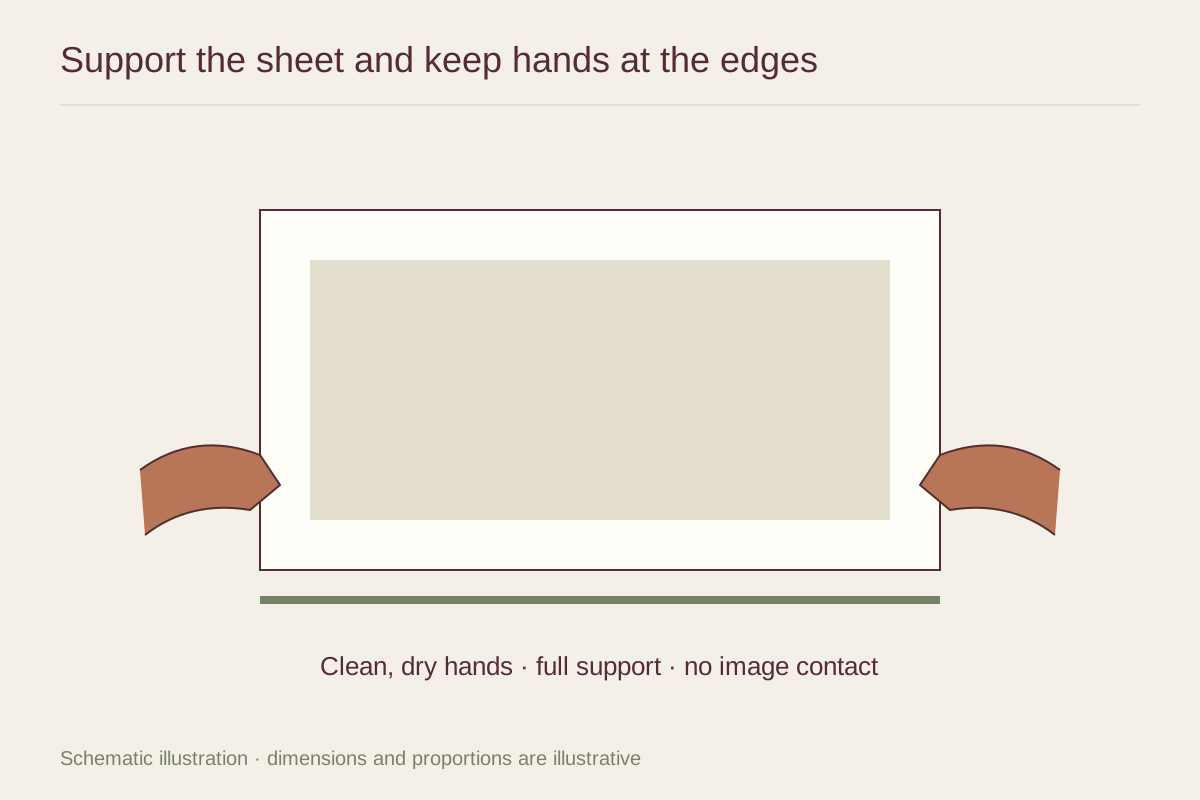
Handle a stable print at its edges and avoid touching the image area. For a large or thin sheet, use a rigid support so the paper does not sag between your hands. The Canadian Conservation Institute recommends supported movement and limiting unnecessary handling of paper objects.
Do not lift a print by one corner or slide it across a gritty surface. If it needs to be turned, consider whether a professional should do that, especially for a fragile or valuable work. A quick look at the reverse is not worth creating a crease through an unsupported sheet.
Leave surface marks alone
If you notice dust, a fingerprint, or an unfamiliar spot, resist rubbing it with a cloth or eraser. Photographic and printed coatings can be easily damaged, and a mark may be part of the image itself. The Library of Congress cautions that even soft brushes can scratch photographs.
For a newly delivered print, document the concern and contact the seller before attempting any cleaning. For an older or important work, ask a conservator. Return the print to an appropriate enclosure between inspections. Good handling means preserving the surface you have, including leaving an uncertain problem untouched until someone can identify it.