Identify the surface
Check the framing invoice, label, or care card for the manufacturer and product name. Acrylic products and optical coatings can have different requirements from ordinary glass. A cleaner or polish that is appropriate for one surface may damage another. Tru Vue, for example, publishes product-specific care guidance rather than one universal method for all glazing.
If you cannot identify the material, ask the framer before applying liquid. Do not test a strong cleaner in a corner of an assembled frame; that corner may still be close to the artwork and the test can leave permanent damage. A little uncertainty is a reason to obtain information, not to experiment.
Make the frame stable
For a small, sound frame that you can safely move, work in a clean, supported position. Large, heavy, damaged, or elaborately finished frames may need professional handling. Do not press against a frame while it hangs loosely on one attachment or balance it on a narrow ledge to reach the glass.
Keep cleaning materials away from the frame's open edges and back. Inspect for cracks, chips, loose corners, or signs that the artwork is touching the glazing. Those are framing concerns to resolve before routine cleaning continues.
Keep liquid off the frame assembly
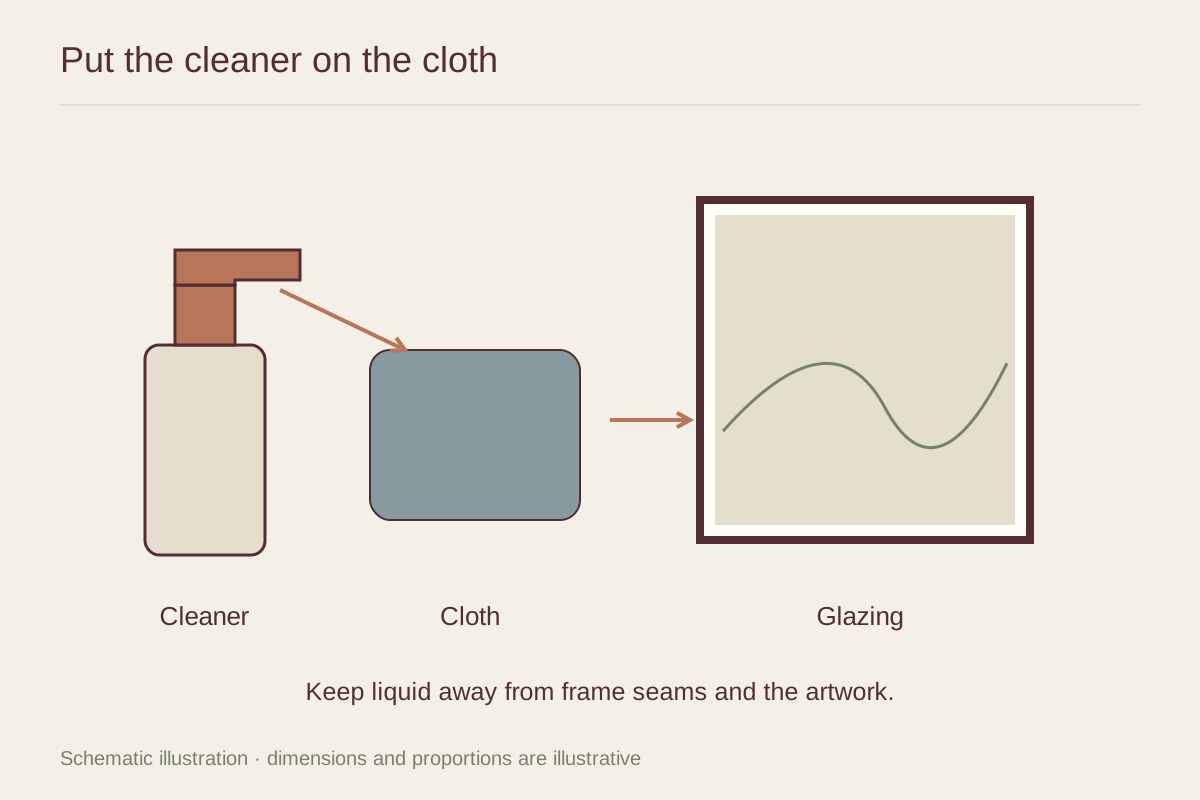
Follow the glazing manufacturer's method, using the specified clean, nonabrasive cloth. If a liquid is permitted, apply a small amount to the cloth rather than spraying the assembled frame. The cloth should not drip. Avoid allowing moisture to collect along the lower edge or reach the molding and backing.
Work gently without pressing the glazing toward the artwork. Use a separate clean area of the cloth as needed, and stop if particles could scratch the surface. Do not use paper towels, abrasive pads, or household polishing compounds unless the exact product instructions explicitly permit them.
Know when the mark is inside
A spot that remains after appropriate exterior cleaning may be on the inner glazing surface or on the artwork. Do not keep rubbing harder to find out. Look from different angles and ask the framer to inspect the assembly if needed. Opening a frame creates a new handling task and should not be an automatic continuation of dusting.
If liquid has entered the frame, or the print appears stuck to the glazing, stop and seek professional advice. Do not apply heat or try to peel the paper away. Keep the glazing details with the frame records so the next cleaning can begin with the correct instructions instead of another guess.