Decide whether the location is suitable
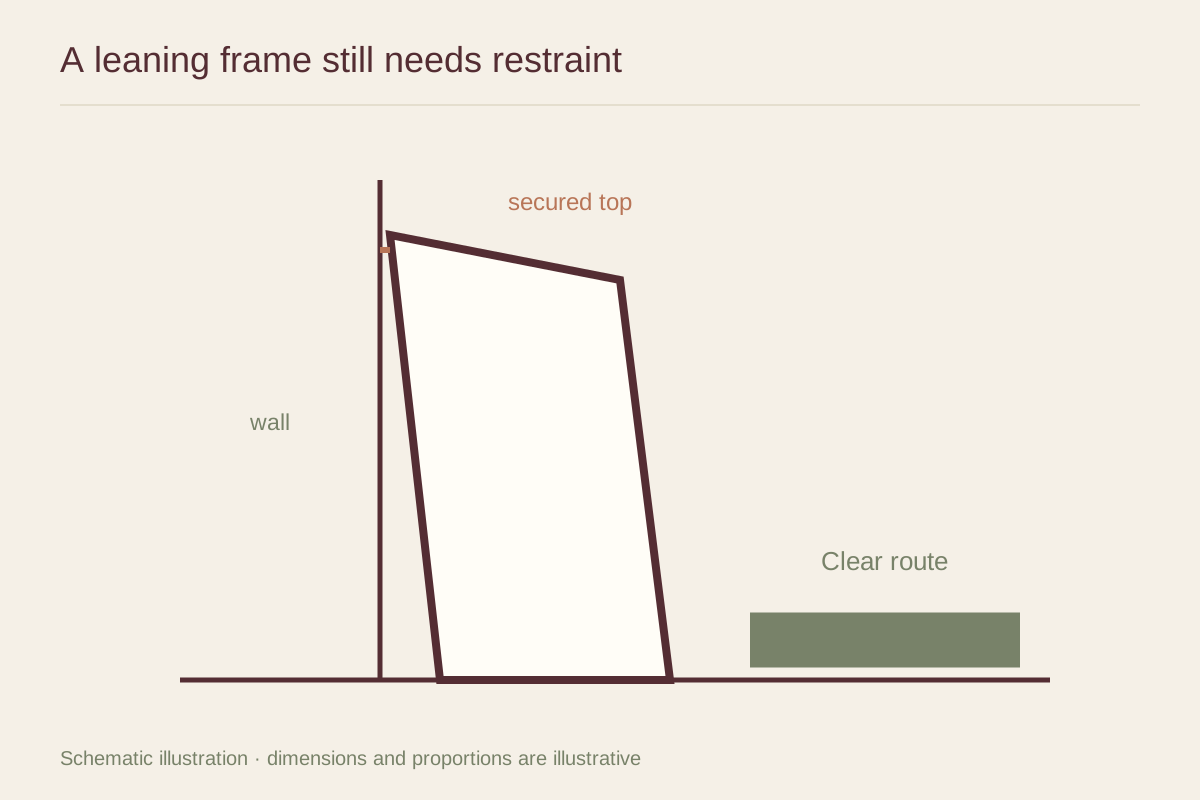
Keep the frame out of door swings, walking routes, vacuuming paths, and places where people set down bags. Consider children, pets, and visitors who may touch or pull it. A quiet corner for one household can be an active play or climbing area for another.
Check the floor and baseboard. A slippery surface, thick carpet, uneven floor, or projecting baseboard can change how the frame sits. A frame that appears stable during a brief trial may shift when the floor vibrates, the carpet compresses, or someone brushes past it.
Ask whether the frame can be displayed this way
Not every frame is designed to rest on its lower edge. The profile, joints, glazing, and backing may not tolerate the proposed contact or angle. Ask the frame maker or a qualified framer whether leaning is appropriate and how the object should be supported and restrained.
A purpose-designed stand or secure wall-mounted system may provide the appearance you want with clearer support. Follow its instructions for compatible objects, dimensions, load, and wall or floor conditions. A generic furniture anti-tip strap should not be assumed suitable for every picture frame without confirming the attachment method.
Do not rely on a small decorative object in front of the frame as a stop. A vase, book stack, or planter can move and may introduce additional hazards or moisture. The restraint needs a physical purpose and a suitable connection, even when it is visually discreet.
Consider the glazing and weight
Glass can make a large frame heavy and can break if the frame falls or is struck. Acrylic may reduce weight and has different breakage behavior, but it can scratch and does not solve tipping or sliding. Ask the framer about the complete package rather than choosing glazing in isolation.
Measure the full outside dimensions and weight before selecting any support. Large frames can be awkward to handle even when relatively light. Arrange help to move them and keep the carrying route clear, using the frame maker's handling guidance where provided.
Choose a composition that works at floor level
Art on the floor is viewed from above and often at an angle. A low-detail image or broad composition may remain clearer than a small drawing in a large mat. Test the view from the doorway and the nearby seats before committing to a large purchase.
Leave enough space around the frame that it reads as a deliberate display rather than an object waiting to be hung. Avoid surrounding it with several other loose frames unless each has a stable, suitable support. Layering increases the number of contact points and can make movement harder to predict.
Plan cleaning and later changes
Keep the artwork away from damp mopping, plant watering, and possible leaks. The Library of Congress recommends keeping framed paper objects off the floor, which is a useful reason to choose another display method for vulnerable or important works.
Recheck the arrangement after moving furniture, changing flooring, or adding a pet or child to the household. Do not leave a restraint disconnected after cleaning. If the frame cannot be safely supported and protected in the proposed location, hang it securely on a suitable wall or use a different piece. The visual effect is optional; stable support is part of the display.