Measure the full movement
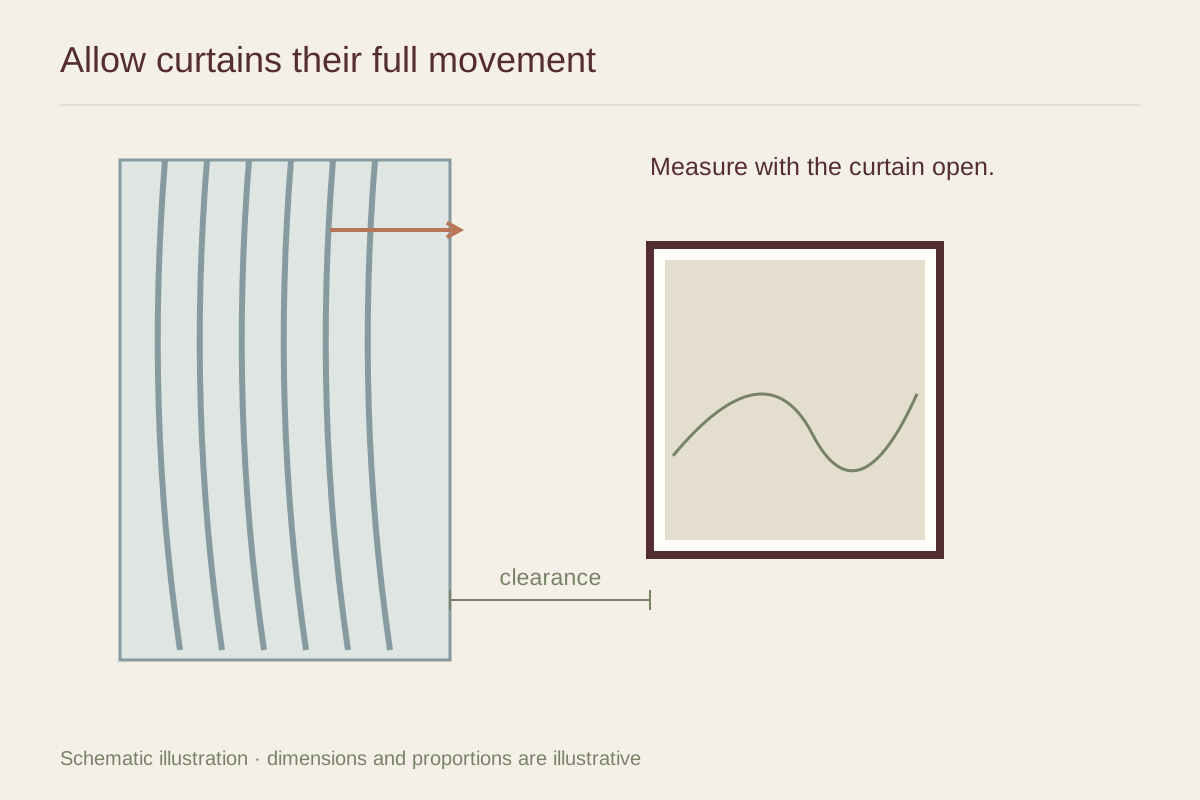
Open and close the curtains completely. Note the widest stack of fabric, the position of tiebacks, and the reach of any wand or cord. Leave the frame clear of those moving parts so the fabric does not brush the glazing or catch on a corner.
Include the rod and finials in the visual plan. A frame placed immediately below a projecting finial may look crowded even when the curtain itself clears it. Test the full frame outline rather than only the image size.
Choose a relationship with the fabric
A plain curtain can sit comfortably beside a detailed print. A bold patterned curtain may benefit from art with larger, quieter shapes. You can repeat one color from the fabric, but avoid requiring the image to behave like a matching textile.
Look at the frame against both the wall and the curtain. A dark edge may give a pale image definition, while a wood frame can connect with other room materials. If the curtain and artwork already contain several strong colors, a restrained frame may be enough.
Watch light and access
A wall beside a window may receive direct sun at particular times of year. Observe the light path rather than assuming the curtains always protect the artwork. Keep vulnerable paper and photographs out of direct sun, and consider a different wall if the display depends on remembering to close the curtains every day.
Check the view with the curtains open and closed. The artwork should remain comfortable in both states, even though the balance changes. If the only available gap is extremely narrow, a smaller picture or an empty wall may work better than a frame wedged between fabric and corner. Curtains need room to function, and art needs room to be seen.