Choose the main plane
Stand at the room entrance and in the nearest seat. One wall may face the viewer while the other is seen at a steep angle. Place the strongest image on the more visible plane unless the corner itself is intended as a close-looking spot.
If a chair or small table occupies the corner, relate the art to that grouping. Centering a picture within an odd strip of wall may be less useful than placing it where it accompanies the chair. A paper template makes the distinction easy to compare.
Use both walls only with a reason
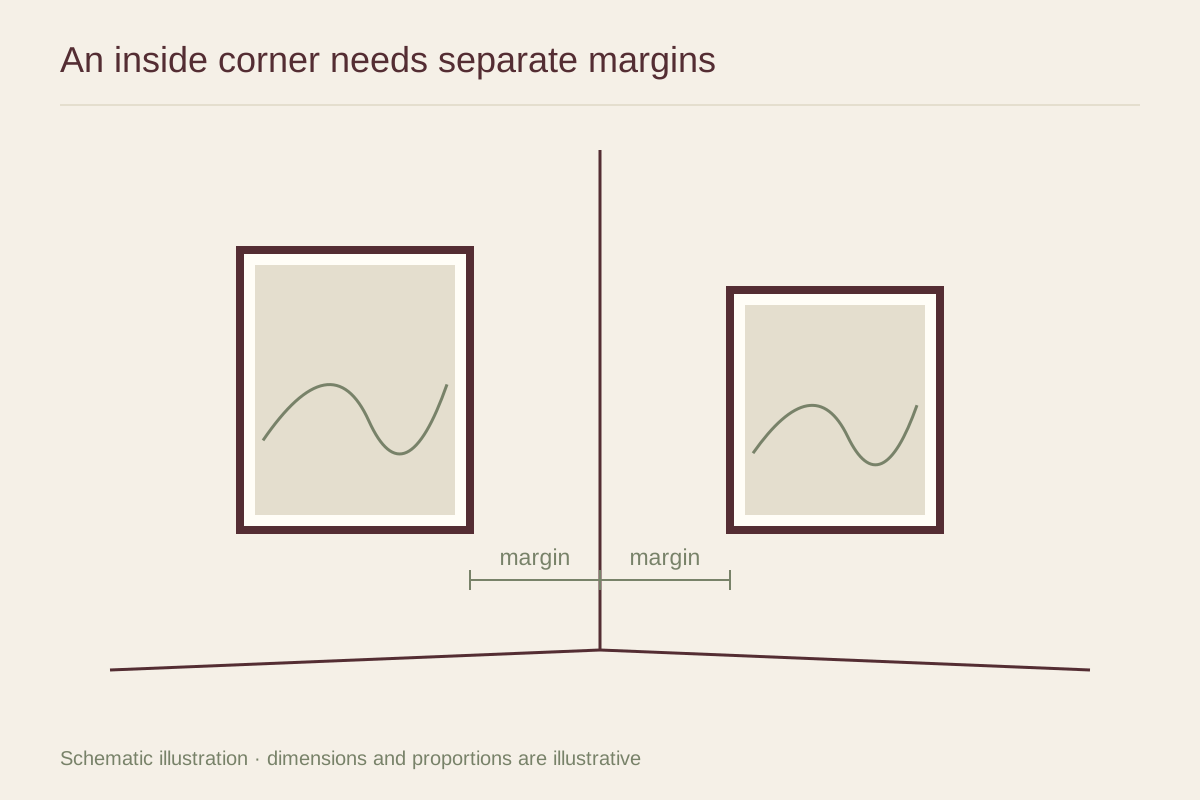
Two pictures on adjoining walls can feel connected through a shared color, frame, or subject. They do not need identical sizes. Leave enough space from the inside corner that the frames do not appear to collide when viewed diagonally.
Check frame depth carefully. Deep profiles near a corner can create awkward shadows or physically interfere with each other. A layout that works as flat rectangles on a drawing may not work with the real objects.
Avoid creating a storage-looking cluster
A group of small frames squeezed into every available patch can make the corner look like a place for leftovers. Choose one or two works that deserve attention and give them a clear relationship. An empty section of wall can help the occupied section feel intentional.
Look at lighting and access. A corner behind a door may receive little light and be difficult to inspect. A spot beside a window may receive direct sun or glare. Choose the image and mounting method for those conditions, and leave the corner unused if no position allows the art to be seen and cared for comfortably.