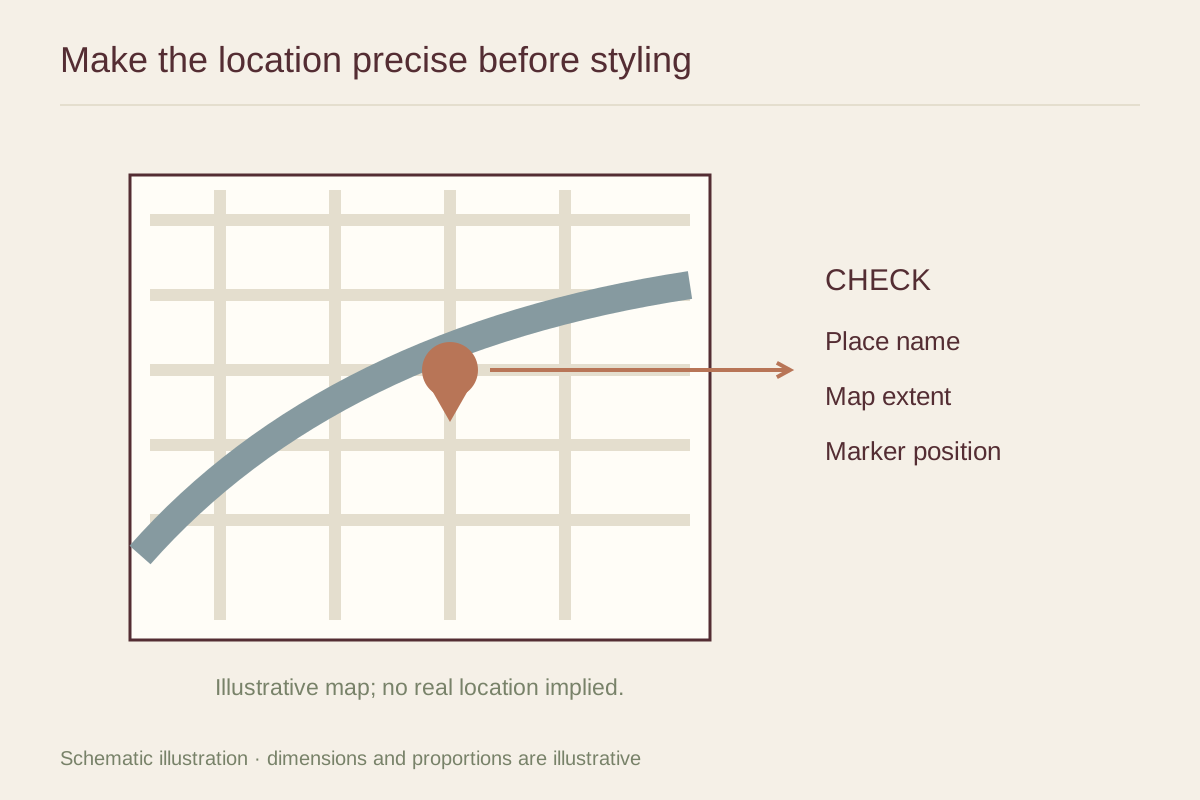
Define the area before choosing a palette
Begin with the point or route that makes the place significant. Then decide how much surrounding geography is needed to recognize it. A neighborhood map may show an exact street clearly; a city-wide map may better communicate the shape of a river or coastline. Trying to do both on a small sheet can make the personal location disappear.
Compare two previews at the final print size. In one, keep the meaningful point near the center. In the other, include a wider landmark that gives it context. The better choice is not necessarily the more detailed map, but the one the recipient can understand without a long explanation.
Check the marker and the label separately
A postal address, a building entrance and a map pin can point to slightly different places. Zoom in on the proof and verify the actual location. If a pin hides the street or building it is supposed to identify, ask whether a smaller marker or an offset label is possible.
Check coordinates if they are printed, including the hemisphere notation and the number of digits. Do not assume that decorative coordinates in a sample image have been replaced with yours. Read place names, punctuation and capitalization exactly as they will appear.
Choose a level of privacy
A print does not need to reveal a full home address to be meaningful. A neighborhood, a city or a short dedication may communicate enough. This matters especially if the artwork might appear in photographs posted online or in a work video background.
For a gift involving another person’s former home, avoid including personal details merely because the customization form has space for them. The useful question is whether the recipient would want that information on a wall.
Make the design readable on paper
Pale roads on a pale background can look delicate in a bright screen preview and become difficult to read in a dim room. Examine the label size, line contrast and the relation between the map and its title. A large title should not reduce the meaningful map area to a small decorative patch.
If the seller offers a printed proof or a close-up preview, use it to judge those details. Confirm the image area as well as the paper size, since a broad border or caption block changes the space available for the map.
Confirm what is being supplied
Some custom maps arrive as downloadable files; others are physical prints. Establish the format, print dimensions, revision arrangements and delivery timing before ordering. If you provide your own map image, confirm that you have permission to use it for the intended product.
In the gift note, explain the memory in a sentence or two. That leaves the artwork free to remain visually simple, while the personal story travels with it.