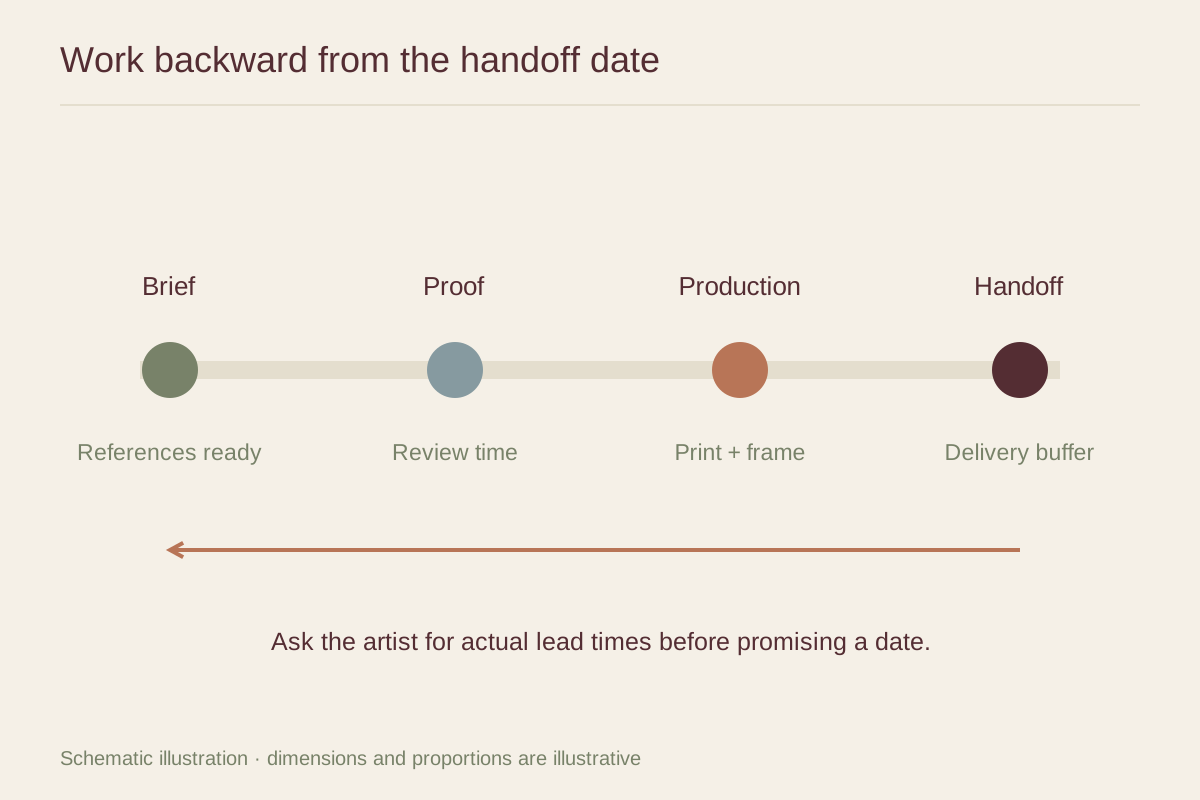
Work backward from the handoff
Begin with the date the gift must be in your hands, not the date of the celebration alone. If you need to wrap it, travel with it or send it onward, those steps require time too. A portrait arriving at your home on the morning you leave is not the same as a gift ready to take with you.
Separate production from shipping. An artist may quote a working period that begins only after the brief is complete, and a printer may start after you approve the final image. Ask what event starts each stage. A place in a queue does not necessarily mean drawing has already begun.
Prepare references before reserving a deadline
Collect the photographs, names, dates and style preferences needed for the work. If another family member holds the only suitable photograph, obtain it before promising the artist a quick response. Delays in reference gathering can consume the time you thought was available for revisions.
For a portrait involving several people or pets, check that every subject has an adequate reference. One missing person can hold up the composition of the entire group. Send an organized set with clear labels and identify the main pose or expression you want.
Ask how proofs fit into the schedule
Find out whether you will see a sketch, a color proof, a final digital preview or some combination of these. Different styles and workflows offer different opportunities for changes. An early sketch may be the right moment to change a pose, while a later proof may be intended only for small corrections.
Ask how long you have to respond and what happens if you miss that window. Put the proof dates in your calendar and make sure the email address used for the order is one you will check. A message lost in a rarely used inbox can interrupt an otherwise realistic schedule.
If several relatives are contributing opinions, agree on one person to collect feedback. Conflicting replies sent directly to the artist can make it unclear which changes are approved. Leave time for your group’s discussion rather than assuming the artist’s revision allowance also covers unlimited family deliberation.
Allow for printing and framing
A digital portrait still needs a physical production plan if the gift is meant to hang on a wall. Confirm the intended print dimensions and file requirements before the artwork is finalized. A file designed for a small square print may not suit a wide frame you have already bought.
If framing is separate, ask the framer about current lead times and whether the print must be present for final measurements. Do not order a custom mat from an approximate product description. The received sheet and image dimensions may need to be checked first.
Shipping estimates are not a guarantee that every parcel will arrive on a particular day. Leave a buffer for an inspection and for correcting a production or delivery problem. The buffer should reflect the route and the services involved, not an arbitrary promise that all custom gifts need the same number of days.
Make a graceful backup plan
If the timeline is too short, consider presenting a card explaining that the portrait is being made. A sketch or proof should only be shared if the artist permits it and the recipient would enjoy seeing the work in progress. Do not present an unfinished image as the final result.
A rushed commission can create pressure to approve a proof before checking it carefully. It is usually better to give a clear, honest explanation of the later arrival than to turn a meaningful gift into a deadline problem for everyone involved.
Keep one written schedule
Record the agreed reference deadline, expected proof stage, response window, production arrangement and delivery method in one place. Update it when a change is agreed. This is not a substitute for the seller’s terms; it is a way to keep your own responsibilities visible.
Before paying for an expedited option, ask exactly which stage becomes faster. Faster shipping does not shorten an artist’s queue, and a rush drawing service may not include rush framing. Knowing the distinction helps you pay for the step that actually controls the deadline.