Make a complete cast list
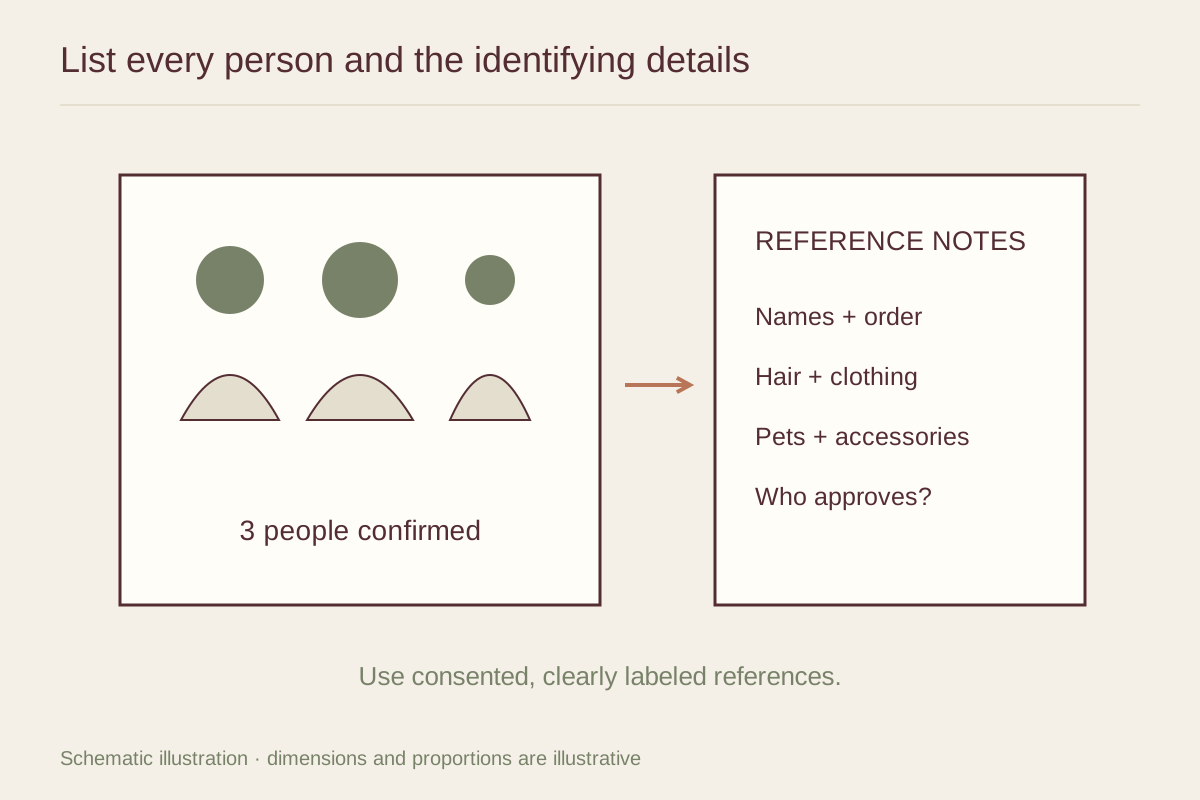
Write one list of everyone who should appear, using names or simple labels that also identify their reference photographs. Include pets if they belong in the illustration. Tell the artist the intended arrangement rather than assuming that the order of uploaded files will determine it.
For a multigenerational group, note relative heights and the relationships that matter to the composition. A grandparent seated in the center creates a different image from a row of standing figures. If the gift should include someone who has died, explain the intention sensitively and establish whether the artist is comfortable creating that kind of combined portrait.
Decide whether the illustration represents the family now or at a particular time. A child’s age, a familiar hairstyle or a pet’s appearance can change significantly between reference pictures. Mixing different years without direction may produce an image that never feels quite right.
Give each reference a job
Choose a primary photograph for each person’s face and identify any extra photograph that shows clothing, posture or a hairstyle. Good reference organization prevents an artist from borrowing an unwanted detail simply because it is clearest in another image.
Where possible, use photographs taken from similar angles. A dramatic side view of one person and a close overhead view of another require more interpretation to combine. The artist may request alternatives. Send them before the composition is finalized rather than expecting the issue to be solved at the proof stage.
Make sure you have permission to supply the photographs for the commission. Do not send private family images through a public review or social comment when the artist has provided a more appropriate upload or messaging channel.
Select details that survive the scale
At a small print size, tiny jewelry, patterned shirts and detailed facial features may be simplified. Ask how much detail the chosen style includes. A faceless illustration can communicate a family through posture and clothing, but it cannot meet an expectation for a realistic likeness.
Choose a few recognizable details rather than requesting every memory in one picture. A familiar sweater, a pet’s markings or the way two people stand together can be enough. If the artwork needs a long explanation to identify everyone, reconsider the layout or the format.
Resolve text and background early
A family name, a short phrase or a date should be supplied as final typed text. Check apostrophes and surnames with more than one possible spelling. If people have different surnames, a neutral dedication may be more comfortable than labeling the whole group with one name.
The background can be a simple color, a house or a meaningful landscape. A detailed setting changes the workload and may compete with a large group. Ask whether background changes are included in the order or count as a separate request.
Review the proof in two passes
First inspect the composition: the correct people, relative sizes, pose and placement. Then check individual details such as hair color, glasses, clothing and spelling. Keep the feedback in one organized message, identifying the person and the requested change rather than using vague descriptions such as “the one on the left.”
Confirm the number of revision rounds and what happens after approval. A correction to a supplied name and a complete change of illustration style may be treated differently. Save the final approved proof and the agreed print dimensions, so the finished gift can be checked against the same reference when it arrives.