Decide what holds the three pictures together
Choose one organizing idea before selecting the final files. It might be a journey from arrival to departure, three details from a family home or portraits taken in the same light. A shared subject gives the group a reason to exist beyond filling three openings.
The pictures do not have to be nearly identical. In fact, three versions of the same pose can feel repetitive. Look for a useful difference in distance, detail or action while preserving a connection through color, setting or mood.
Try a wide scene, a middle-distance view and a close detail. Alternatively, choose three images with a similar scale for a quieter rhythm. Put them next to one another at a small size and see whether one dominates without a clear reason.
Establish the reading order
For a sequence of events, the order may be chronological. For a landscape, the horizon or direction of movement can suggest how the eye travels across the group. A person looking inward from the left image can connect to the center more comfortably than someone looking out of the arrangement.
Avoid reversing a photograph just to change that direction unless you have considered the result. Mirroring can reverse lettering, landmarks or a familiar face. Choosing another image is often a better solution than making a place look subtly wrong.
Use consistent cropping deliberately
Three matching frame openings create a strong structure, but not every image can tolerate the same crop. Preview each photograph inside the actual opening, including any part covered by a mat. Check heads, hands, horizon lines and important objects near the edges.
If one picture needs a different proportion, you can choose a layout that allows it rather than forcing all three to match. The frames might share a finish and overall height while the mats accommodate different image shapes. Ask a framer about the finished arrangement before ordering custom components.
Check tonal balance
A bright outdoor photograph beside two dim indoor photographs may draw all the attention, even when the subjects are equally important. Look at the three together in the same preview. Similar brightness and color temperature can help them read as a set, but avoid heavy adjustments that distort skin tones or a meaningful scene.
Black and white can connect photographs from different settings, yet it is not an automatic repair for every mismatch. Check whether each image still has enough separation between the subject and background after conversion.
Choose one frame or three
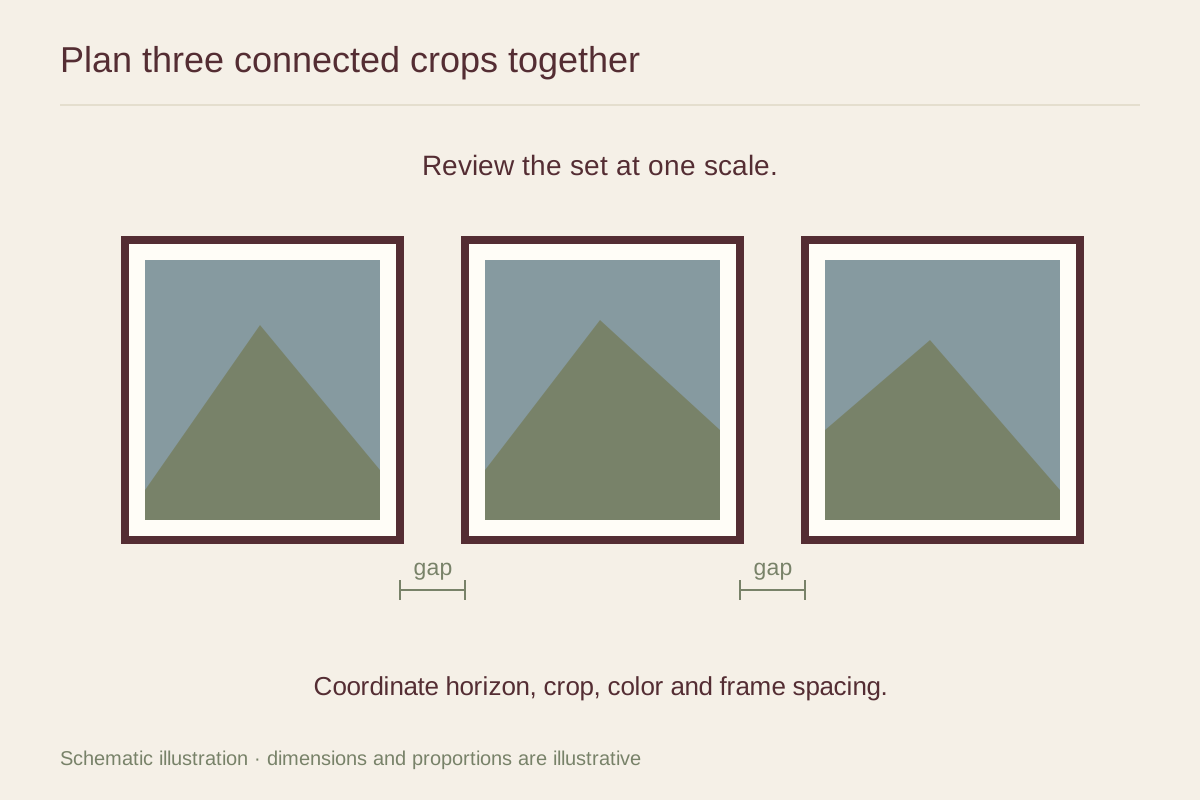
A single frame with three openings keeps the sequence together and simplifies placement. Three separate frames let the recipient change the spacing, but require more hanging decisions and enough wall width for the gaps.
Calculate the complete footprint. Three 8-inch-wide frames with two 2-inch gaps occupy 28 inches, not 24. If the gift is intended for a particular shelf or wall, confirm that total before ordering. The measurement example describes the layout, not a required spacing.
Keep the story with the gift
Number the images discreetly in the packaging or include a small layout sketch so the intended order is clear. If the recipient is free to rearrange them, say so. The arrangement should be an invitation rather than a puzzle.
A separate card can explain the three moments without adding captions to every photograph. Keep original files and the approved crop previews until the prints arrive, then inspect the group together before wrapping.