Read the claim carefully
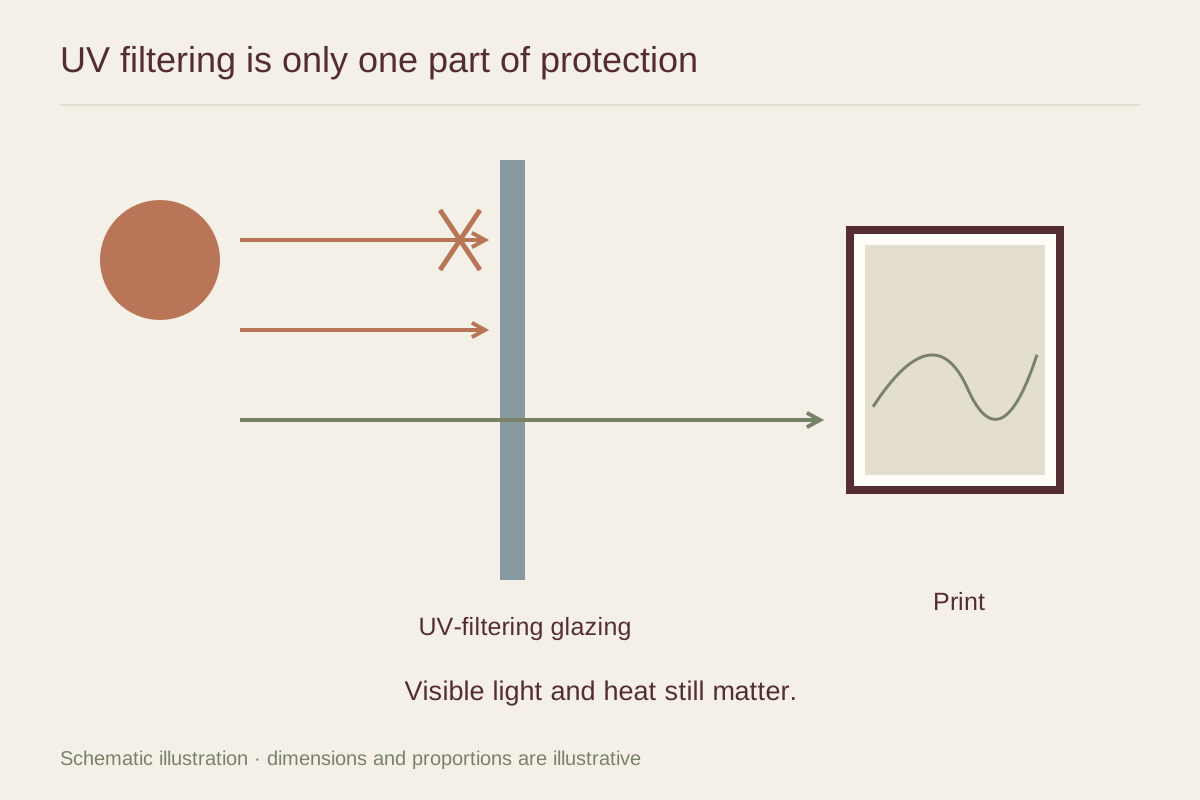
A UV filtering percentage describes performance over a specified range of ultraviolet wavelengths under stated test conditions. It is not the percentage of all fading that will be prevented. Ask for the exact product name and the manufacturer's specification rather than relying on an unqualified description such as museum glass or protective acrylic.
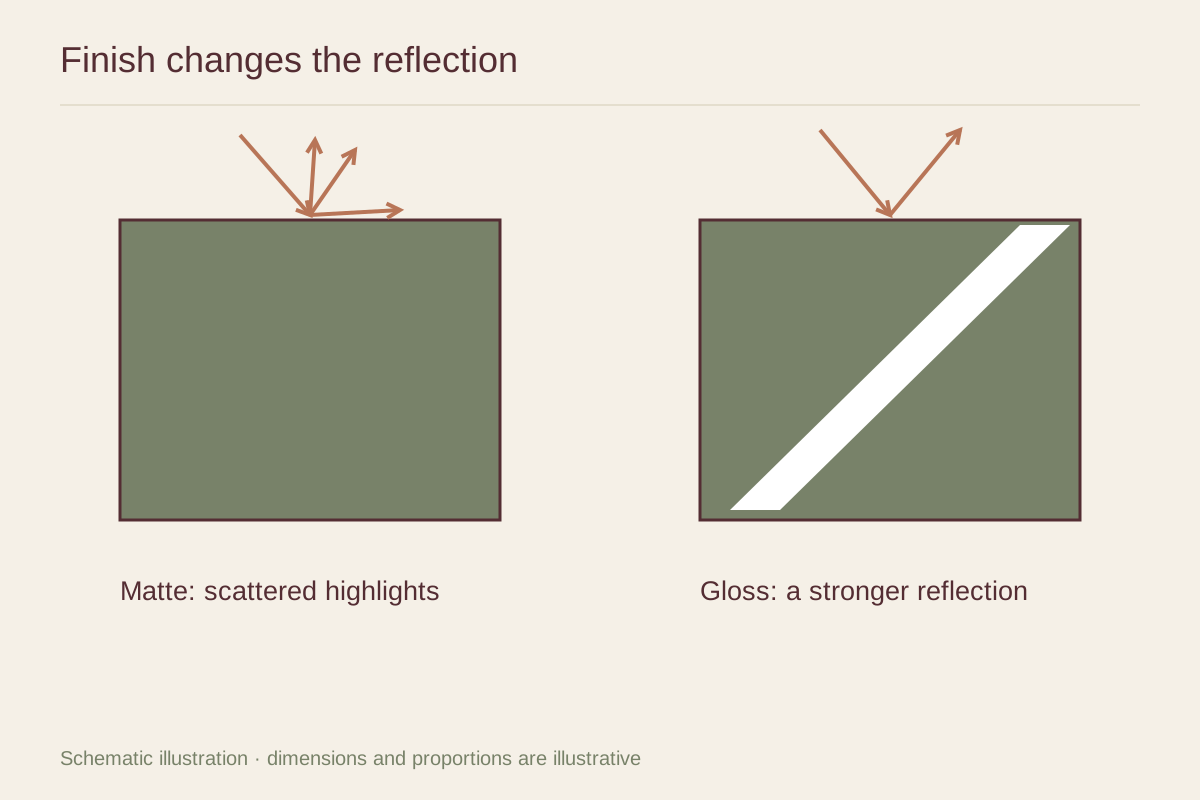
Reflection reduction is another property. A clear view through the glazing does not prove that it filters a particular amount of UV, and strong UV filtering does not guarantee an almost invisible surface. Decide which properties you need and compare them separately. A framer should be able to explain the product being supplied in those terms.
Visible light still matters
Light damage depends on the material, the intensity of light, and how long the object is exposed. Visible light can also alter colorants and paper. NEDCC describes light damage as cumulative and irreversible: putting an already faded print in a dark cupboard does not restore its original color.
For home planning, this means that a well-glazed print still benefits from a location away from direct sun and from sensible limits on unnecessary lighting. Do not use the promise of UV filtering as a reason to place a delicate work in the brightest part of a sunroom. The room and the frame contribute different kinds of protection.
Evaluate the wall over a day
A wall that looks shaded at breakfast may receive a sharp rectangle of afternoon sun. Observe the intended location at several times, and remember that the sun's path changes with the season. Check nearby mirrors and bright reflective surfaces too; a lighting problem may come from an unexpected direction.
Make a simple location note with your frame measurements. Write down when sunlight reaches the wall and whether shades are usually closed. This is more useful than describing the room as north facing without looking at the actual window arrangement. If daily shading would be inconvenient, choose another wall rather than depending on a routine you will not maintain.
Match expectations to the object
A replaceable contemporary poster, a family photograph, and an older hand-colored print can have very different sensitivities and significance. Unknown materials make precise lifespan predictions especially unreliable. For a valuable, fragile, or irreplaceable work, ask a conservator about display conditions and whether a reproduction would be a better choice for continuous display.
The framing package deserves attention beyond the front pane. Appropriate support, separation from the glazing, and suitable materials around the print all matter. Buying a high-specification glazing product while leaving a print adhered to an unsuitable backing does not resolve the other problems. Ask the framer to assess the whole object.
Keep a record without inventing a lifespan
Save the glazing product details, the date of framing, and a photograph of the print under consistent lighting. The photograph is a reference, not a laboratory test for fading. It can help you notice obvious changes or explain a concern to a professional, but a phone camera's automatic processing prevents precise color comparisons.
Avoid translating a product claim into a promise that your artwork will last a certain number of years. Display conditions, inks, paper, past treatment, and the print's initial condition remain relevant. A more useful goal is to reduce avoidable exposure, choose a suitable frame, and make the display easy to maintain. UV filtering is one part of that decision, with a clear benefit and a clear limit.