Separate the two terms
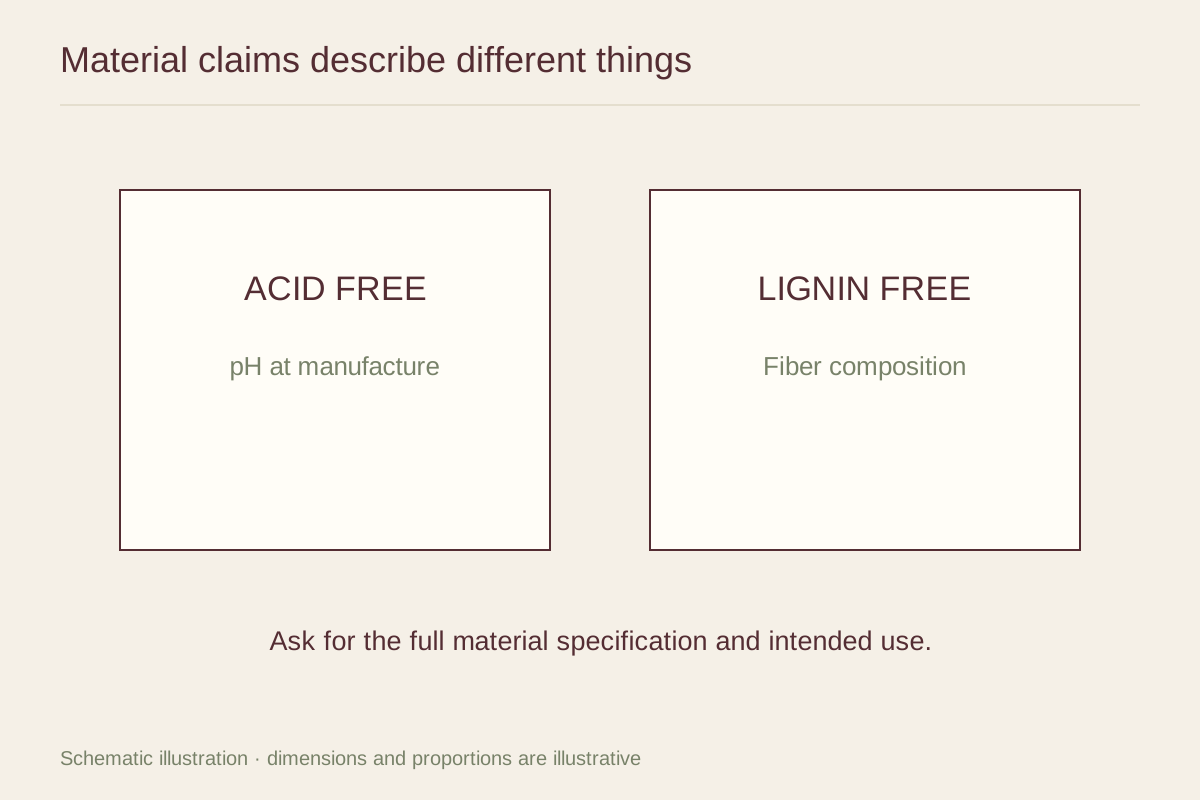
Acid free generally refers to a material's pH at the time it is assessed or manufactured. Lignin is a component of plant material that can contribute to deterioration in paper. A sheet can be treated to be acid free while still containing components that make it less stable over time. That is why preservation suppliers often specify both characteristics.
A buffered paper contains an alkaline reserve intended to help neutralize acids. Buffering is suitable for many paper objects, but not every photographic or artistic process responds the same way. If the image material is unknown or sensitive, ask a conservator or knowledgeable framer to choose the enclosure. Do not assume that more alkalinity always means better protection.
Ask which part of the board is described
A mat has more than a visible colored face. Its core and backing layers may differ, and the cut bevel exposes the core. Ask whether the stated material specification applies to the whole board. The question is especially useful when a product uses a conservation-sounding label without giving its construction.
The backing behind the artwork also matters. A carefully chosen mat does not compensate for an unsuitable board pressed against the reverse of the print. Discuss the complete package, including supports and attachments, and obtain the product names rather than a general assurance that everything is archival.
Use specific information instead of reassurance
For a new decorative reproduction, a seller may provide the paper and ink names but little else. Keep those details and ask the framer to work from them. For an older print, you may have no reliable material information. Describe what is known and avoid guessing that a glossy surface is a particular photographic process.
For photographic enclosures, the Photographic Activity Test is another relevant specification. It evaluates interactions with photographic materials; it does not certify every aspect of an entire frame or promise an unlimited lifespan. Ask what has been tested and how that result relates to the enclosure you are buying.
Do not let a label dictate a repair
An adhesive tape labeled acid free is still an adhesive tape. It may be difficult to remove or unsuitable for direct contact with the artwork. Material labels do not turn a home repair into a reversible conservation treatment. If a print is torn, stained, or attached to an old backing, obtain professional advice before trying to replace its materials.
Likewise, a yellowed mat is a reason to inspect the framing arrangement, not proof of a single diagnosis. Several materials and environmental factors can affect appearance. Record what you see, keep the work supported, and let a qualified person examine a fragile or important object.
Write a useful purchase specification
For a framing order, ask the shop to identify the mat board, backing board, glazing, and mounting approach. If the print has a special process, note that too. This gives you a record that can be checked later and makes it easier to compare two quotations that otherwise use the same broad marketing words.
For storage, buy an enclosure sized to support the sheet and suited to its media. A technically appropriate folder that is much too small or badly overfilled still creates a physical problem. Chemical suitability and physical support should be considered together. The best use of these terms is to prompt a precise conversation about the object, rather than to end that conversation with a reassuring label.