Recognize the measurement problems
An irregular sheet, a signed border, or an image very close to the paper edge can make a standard mat unsuitable. A framer can measure the visible area and design a window or whole-sheet presentation around it. This can avoid trimming the artwork to match a frame that happened to be available.
Large prints create another challenge. They need an assembly that remains stable at that scale, with appropriate glazing thickness, backing, frame strength, and hanging hardware. A narrow molding that works for a small photograph is not automatically appropriate when enlarged. Ask the framer to assess the complete dimensions and finished weight.
Identify materials that need particular care
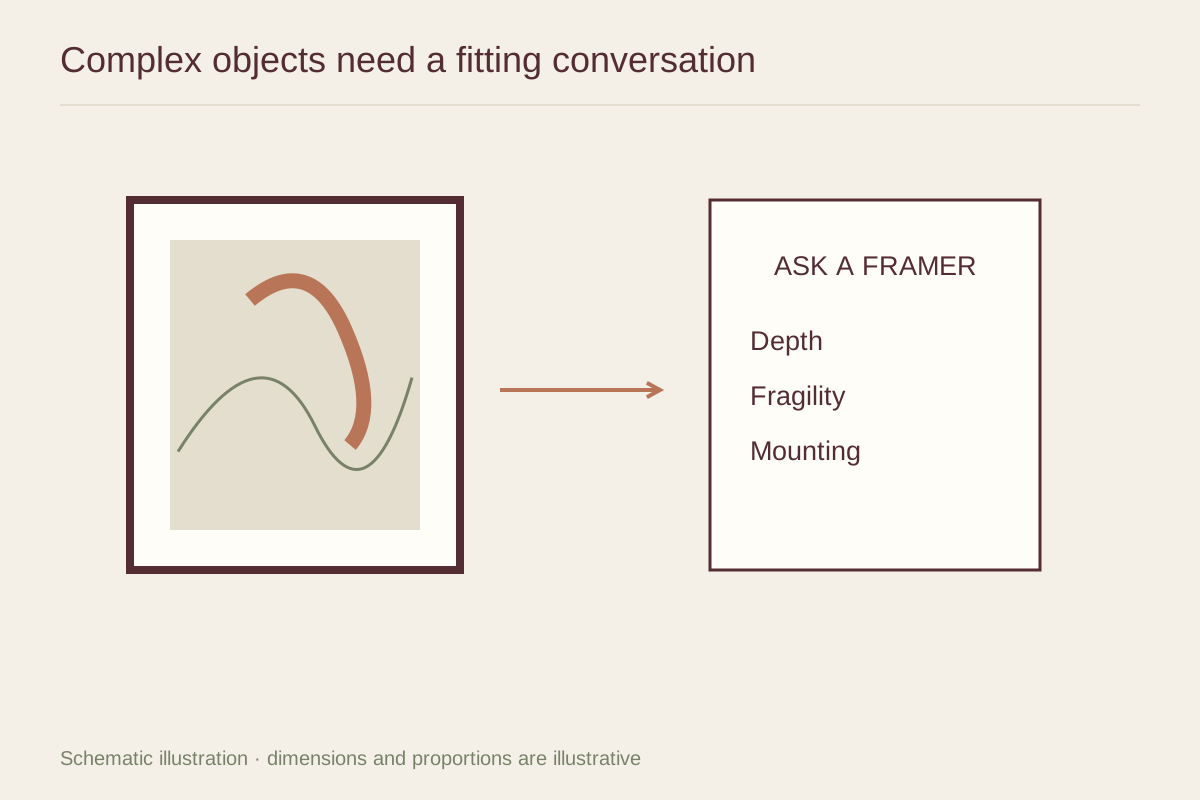
Loose drawing media, raised details, unusual photographic processes, and very thin papers require specific framing choices. Static, pressure, adhesives, and glazing clearance may matter. If you do not know what the object is made from, say so; a good consultation should not depend on your ability to identify it from appearance alone.
A print that is actively damaged needs a different kind of help. Tears, flaking, mold, adhesion to glazing, or staining associated with old attachments may call for a conservator before a framer proceeds. A frame shop may be able to recommend one, but framing and conservation treatment are distinct services. Ask who would actually assess and treat the object.
Prepare for the consultation
Bring the artwork in a suitable protective enclosure and arrange transport in advance for a large or fragile piece. Take a photograph of the room, the wall measurements, and any frame finishes you want to compare. State whether the display is temporary, frequently rotated, or intended to stay in place for years.
Explain what must remain visible: a signature, deckled edge, caption, plate mark, or the entire paper border. Also mention practical limits such as a narrow passage, a busy family room, or a wall that receives afternoon sunlight. These details help the framer propose a construction as well as a color scheme.
Request an itemized proposal
The quotation should identify the molding, mat or spacers, glazing, backing, mounting approach, and installation hardware where supplied. Ask which components are optional visual upgrades and which are needed for the object. This makes comparison easier than judging two prices attached to the same vague phrase custom framing.
Ask how the print will be attached and what future removal would involve. Avoid approving full-surface bonding without understanding its consequences. If the work is valuable or irreplaceable, discuss a conservation-oriented approach and whether specialist advice is warranted before any intervention.
Inspect the finished piece together
At collection, view the frame upright and check the intended opening, visible borders, corner joints, and any particles inside the glazing. Confirm that the orientation and hanging arrangement match your plan. Raise an issue while the framer can examine it with you rather than opening the frame later at home.
Keep the care instructions and product details. If installation is included, confirm the wall type and location before the visit. If you will hang it yourself, ask for the total weight and the required attachment method. Professional framing is most useful when it resolves the whole presentation: a supported object, a coherent appearance, and a mounting plan that fits the room.