Consider where the frame will live
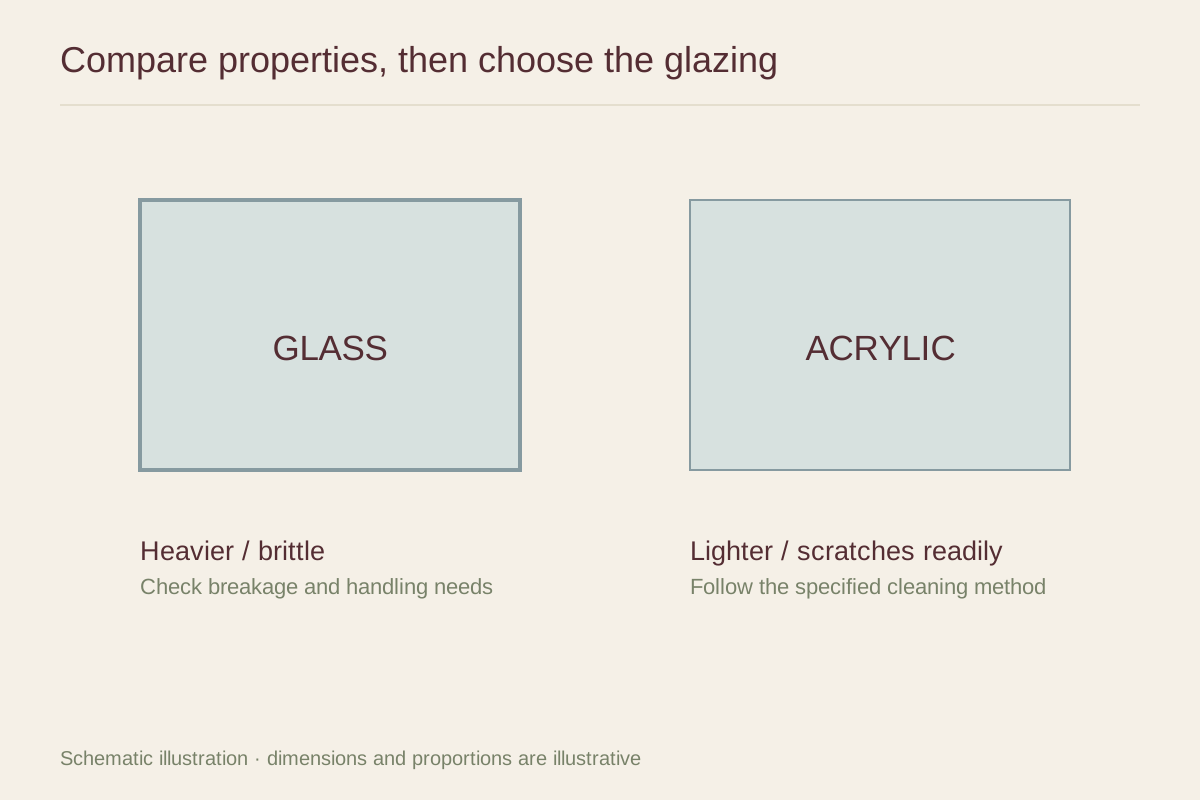
For a small frame in a protected location, the weight of ordinary glass may be manageable. For a large work, a display near active children, or an object that will travel, acrylic's lower weight and greater resistance to shattering can be useful. The finished frame still needs secure attachments: lighter glazing does not make an unsuitable wall fastener reliable.
Think about the consequences of a collision as well as the likelihood. A low frame beside a busy passage faces different conditions from a frame on a quiet study wall. If glass is already cracked or chipped, stop using that assembly until a framer can assess it. Do not try to solve a damaged pane with a decorative strip that hides the defect.
Look beyond the material name
Both glass and acrylic may be available with UV filtering, reflection-reducing treatments, or other specialized coatings. Standard acrylic is not automatically equivalent to a particular conservation product, and ordinary glass is not the same as optically coated glass. Compare the exact product names and published properties.
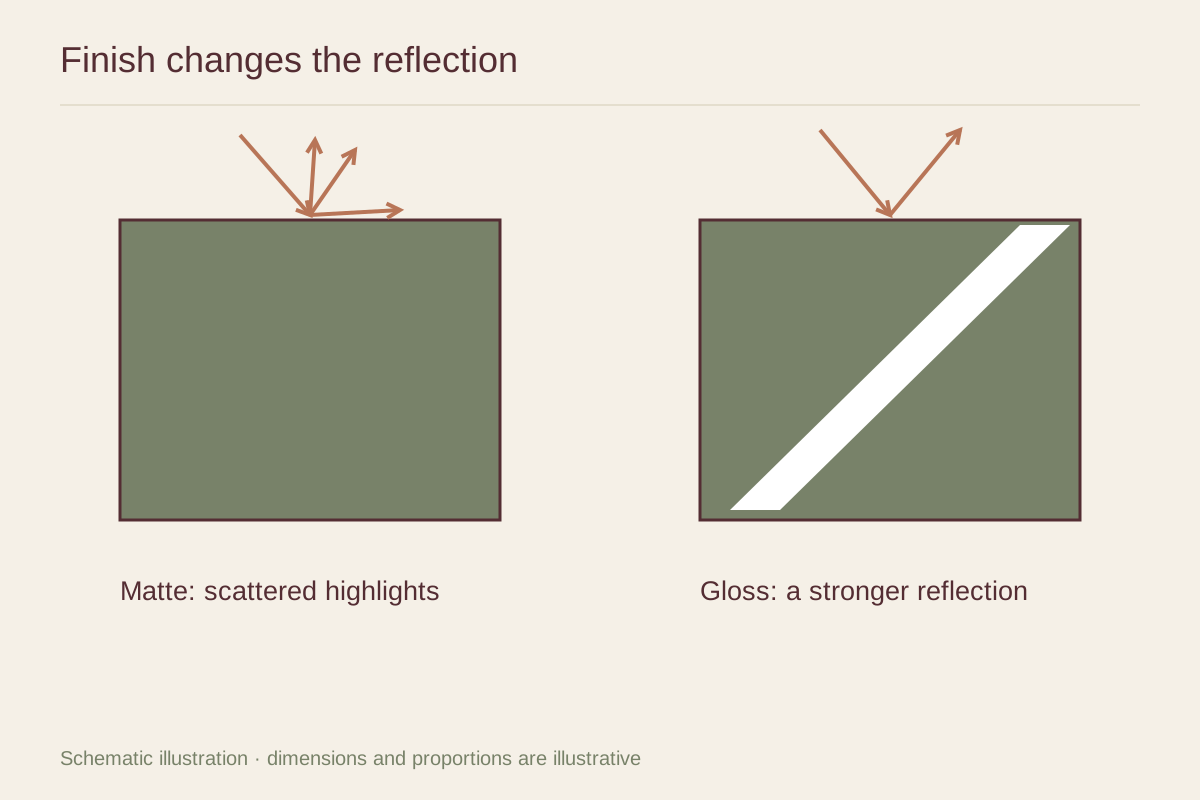
Ask the framer to show a glazing sample over a dark and a pale part of the print. Move it slightly so you can see reflections and any color cast. A demonstration against black velvet can make a difference in reflections obvious, but your own image is the more useful final test. Pay particular attention to delicate gray tones and white paper borders.
Account for static and surface sensitivity
Ordinary acrylic can develop static charge. That can be a concern around loose or powdery media, such as pastel, charcoal, or flaking paint. Some specialized acrylic products have antistatic coatings, but the choice should be made with a framer or conservator who understands the artwork. Do not treat a general-purpose acrylic sheet as appropriate for every drawing.
A print reproduced from a pastel drawing is a different object from the original pastel. Tell the framer whether the surface contains loose drawing material or a printed image. If you do not know, have it identified before selecting the glazing and spacing. The distinction affects construction as well as shopping terminology.
Provide space and a suitable frame
The glazing should not be pressed against the artwork. Mats or appropriate spacers establish separation, and the frame needs enough depth to hold the full package securely. Larger acrylic sheets can flex, so the glazing thickness and internal spacing need to suit the dimensions. This is a reason to consult a framer for a large custom piece rather than scaling up a small frame recipe.
Measure the total framed object when planning the wall. Switching to acrylic may reduce weight, but a large mat and backing still need a rigid frame. The molding, retaining hardware, glazing, and wall attachments form one system; evaluate them together.
Keep the care instructions
Acrylic can scratch, and coatings have their own cleaning requirements. Glass cleaners, plastic polishes, and abrasive cloths are not interchangeable solutions. Keep the product label or invoice and follow the manufacturer instructions for that exact surface. If the glazing cannot be identified, ask the framer before applying a cleaner.
Record the choice in plain language, such as the manufacturer, product name, thickness, and installation date. That small record helps anyone who cleans or reframes the piece later. It also makes a future comparison meaningful: you can request the same material or understand precisely what is changing instead of starting again with the vague choice between glass and plastic.